Geometric wounds on the body
Dr. DeathGeometric wounds on the body connect the investigation of Eldon Mate’s murder to photographs, artistic ambition, and a second pair of victims. Squares on Mate’s abdomen and triangles on Alice Zoghbie and Roy Haiselden make violence appear designed, but resemblance alone cannot establish who inflicted it. The pattern is at once a disturbing image and a problem of interpretation: Alex Delaware is drawn to its possible meaning, then reminded that killers may share a method without sharing an identity.
A pattern first seen in images
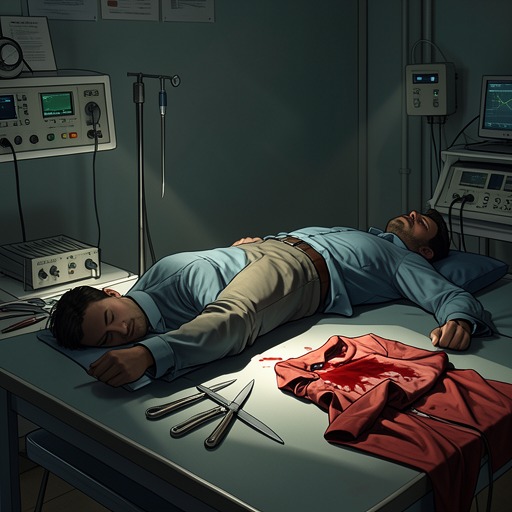
The motif first takes shape for Alex through photographs of women’s bodies and close views of abdominal injuries. On gray paper, the wounds become plum-colored shapes; their precise edges make them look almost composed. That transformation from injury to image unsettles him. He imagines that Mate would have appreciated the pictures, then wonders whether Mate had sensed what was happening to him. The thought links the images to the dead man without resolving what Mate knew or what the resemblance means.
Alex tries to match the photographed geometry to the concentric squares cut into Mate’s abdomen. The connection feels compelling, but not exact enough to settle the question. Recalling the crime-scene photographs that Milo Sturgis had shown him from Mulholland, Alex recognizes the pull of equivalence: if the marks look alike, they may seem to tell one continuous story. Yet Milo’s caution remains decisive. Many killers carve. Repetition can direct attention, but it cannot by itself identify a perpetrator.
That distinction gives the pattern its investigative force and its limit. The wounds are concrete evidence of deliberate marking; their shape invites comparison across cases. But the more insistently Alex seeks concordance, the more necessary it becomes to separate what is visible from what can be inferred. Geometry gives the violence a visual order, not a guaranteed explanation.
Art, imitation, and the imagined father
The photographs also lead Alex to Donny Salcido Mate, who had called himself the Rembrandt of the flesh. Alex associates Donny with The Anatomy Lesson and with the idea of turning death into an artistic act. The association is not proof that Donny committed any killing. It is a hypothesis formed through a convergence of image, family history, and the possibility that artistic identity can become entangled with violence.
Alex’s thinking sharpens into a disturbing imagined address to Donny’s father: perhaps the urge would be to carve Daddy because Donny hated him and wanted to become him. The thought holds resentment and identification together. It suggests a possible logic of imitation, not a confirmed motive or event. In Alex’s mind, the geometric marks become more than a clue about technique: they raise the possibility that an act of violence could also be staged as an artwork and directed at a particular relationship.
The association reaches beyond Donny. Alex thinks of Guillerma Salcido Mate, frozen in a dingy motel room when asked about her only child. He sees her life as lonely: a single mother abandoned by her husband and disappointed by her son. Her regular prayers and expressions of thanks stand in contrast to the imagined drama of carving and artistic self-creation. That contrast does not explain the wounds, but it places the speculation about Donny inside a family marked by separation and disappointment rather than treating the image as an isolated aesthetic puzzle.
The bodies of Alice Zoghbie and Roy Haiselden
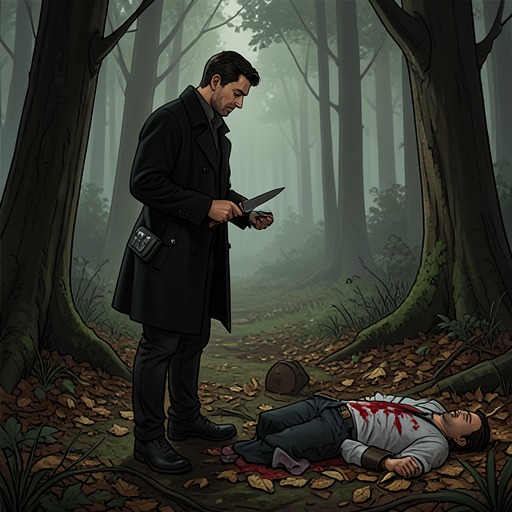
When Alex encounters Alice Zoghbie and Roy Haiselden, geometry is no longer confined to photographs or conjecture. Both bodies have been tied to a tree with thick rope. Triangular marks cross their abdomens, echoing the deliberate geometric pattern that Alex had been trying to connect with Mate’s death. Alice’s clothing has been pulled out of place, and Roy’s has been arranged differently; the presentation of the two bodies makes their shared display unmistakable without making their individual injuries identical.
Their physical arrangement adds another visual element. Roy’s head leans toward Alice, while their left and right hands, respectively, are entwined. The gesture gives the paired display an apparent intimacy amid its violence. The triangles, meanwhile, carry the pattern across two bodies at once. Their repetition strengthens the impression of a designed scene, but the differences between triangles and Mate’s concentric squares keep resemblance from becoming simple identity.
Comparison without certainty
Alex later tells Milo that the bodies had a green tinge, no maggots, and many flies. Milo estimates that they had been dead for a day or two at most, then asks whether their positioning resembles material in Leimert Fusco’s file. Alex says it is identical and confirms the geometric wounds. This exchange gives the motif a practical investigative role: it links the scene to a documented visual pattern and prompts direct comparison, rather than remaining only an unsettling image in Alex’s thoughts.
Even so, the comparison does not establish who killed Alice and Roy, or prove that the same person killed Mate. The narrative preserves the gap between a match in presentation and a solved case. That gap is essential to the motif’s meaning. Geometry seems to promise control, design, and a readable signature; the investigation shows how quickly that promise can outrun the evidence. On the body, a repeated shape is both a mark left by violence and a sign that investigators must interpret cautiously.